

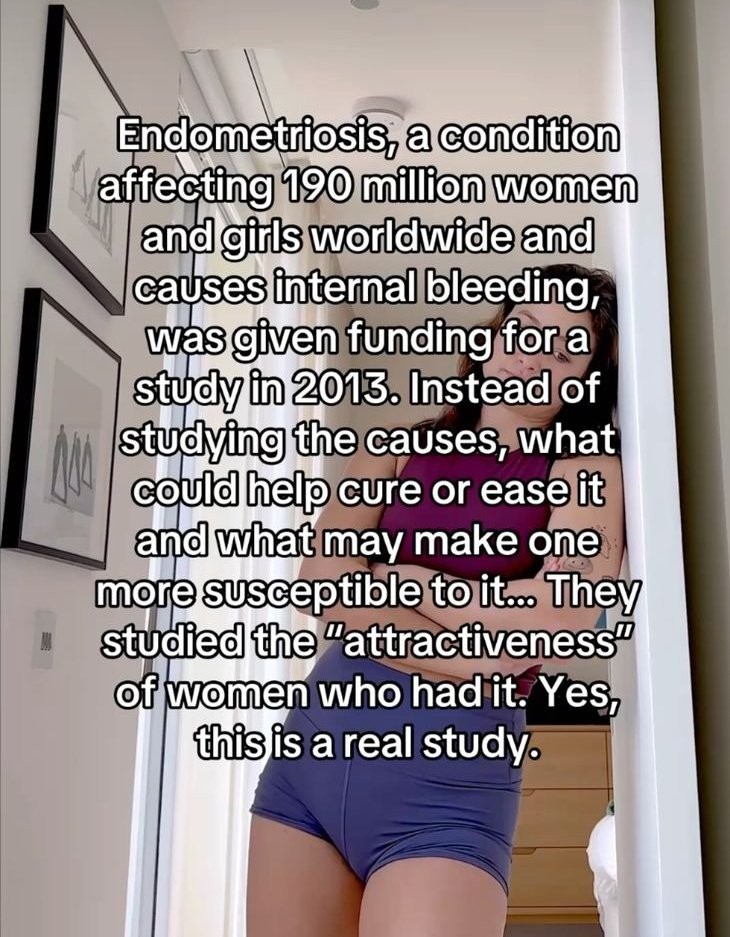
The study later got retracted due to backlash but the fact that it happened at all if fucking baffling.
Don’t forget this study that instead of studying the causes or cures for endo studied the mental effects of the men in a relationship with someone who has endo.
You quoted a bunch of studies about mental health/addiction and attractiveness. It’s should be self-evident why those two things are related.
You didn’t address the topic and quote any studies about physical health and attractiveness. Furthermore, you didn’t quote any studies about female sexual health and attractiveness. Furthermore, you didn’t quote any sources about Caucasian female sexual health and attractiveness. Most importantly you didn’t give us a reason why this particular study needed to happen more than a different junk science study with dubious motivations.
I picked the first results with meaningful amounts of citations. Not an ideal metric but at least correlated with relevance.
But that’s the entire point? Correlations that seem obvious MUST be proven by data. Also, why isn’t it obvious that endometriosis may affect attractiveness? From the retracted study itself:
I haven’t actually read any citations or further. Still, this reasoning seems plausible to me. If endometriosis does actually correlate with a certain phenotype - which I don’t know is true or not, as again I haven’t read the citations - then this relation becomes self-evident just as much as the studies I quoted.
Also, I don’t see why quoted studies must be about the same exact topic. “Caucasian” [why does English even use this outdated term still] female sexual health and its relation to attractiveness sounds like one of these hyperspecific topics where finding relevant studies requires knowledge about which keywords to look for. Knowledge I don’t have.
And I have no clue about what other “junk science” there is in human health research. How would I even be able to point to any other topic there? Besides I am unable to determine whether any study in a field I have zero experience in is junk or not. From Wikipedia:
If you have experience in that general field and can point out why it is junk, please do so.
You picked a bunch of studies where the correlation is obvious.
You have still given no reason why there was a correlation in this study: For example, give me a reason I shouldn’t believe this study wasn’t just a few horny “researchers” trying to get laid. If you read the abstract of the study…they don’t even propose a correlation, or the corresponding reasoning for doing the study in the first place.
You did, however, bloviate and muddy the waters a lot.
If a correlation isn’t immediately obvious, should it not be studied?
The abstract - if it can be even called that, seems more like a technical summsry to me - is useless btw, my quote is from the introduction. It’s more readable and goes a bit into the motivation of the research, which is roughly (if the citations are in order):
Women with endometriosis tend to have a certain phentoype. This phenotype shares traits that correlate with attractiveness. The research question follows: Are women with endometriosis more attractive than those without?
And the researchers were split evenly into men and women (assuming their gender from their names). Perhaps the three women happen to be bisexual or lesbian but I’d argue the chances of them trying to get laid are… very low at best. Do researchers even get laid from doing any studies? I couldn’t think of anything less attractive than analyzing someone’s attractiveness on paper.
You didn’t make an argument. You just basically said “we can’t find out if they’re related unless we study them”.
I asked you to tell me why the study was done in the first place: what do we learn from the potential result? What potential scientific value did it serve? I didn’t ask you to filibuster me.
My hypothesis that the study was done to bring the researchers closer to attractive women is just as valid as any defence of the study.